
It started with a bottle of gin from duty-free. Then came the aquavit from a 50th birthday. Then a tequila from last year's holiday, a cognac from an auction impulse, and suddenly you have a kitchen cupboard that looks more like a forgotten archive than a home bar. The bottles stand packed together, gathering dust, and when you actually want to make something – well, you're still missing the one ingredient you need.
The solution is not more bottles. It's fewer, but better chosen. A home bar that actually works is about flexibility, not completeness. You need eight to ten bottles that cover the fundamental taste directions and techniques – the rest is window dressing.
Think of it like a kitchen. You have salt, pepper, olive oil, lemon. With those you can make a thousand dishes. The same applies to the bar. A few solid bases, the right technique, and suddenly you can improvise your way through almost anything.

The Foundation: gin and whisky
Two categories carry almost any home bar: gin and whisky. Gin gives you access to classic cocktails – from Martini to Negroni – and works brilliantly in simple everyday drinks. Choose a classic London Dry with a clear juniper character. It should hold its own against tonic, citrus, and bitters without disappearing.
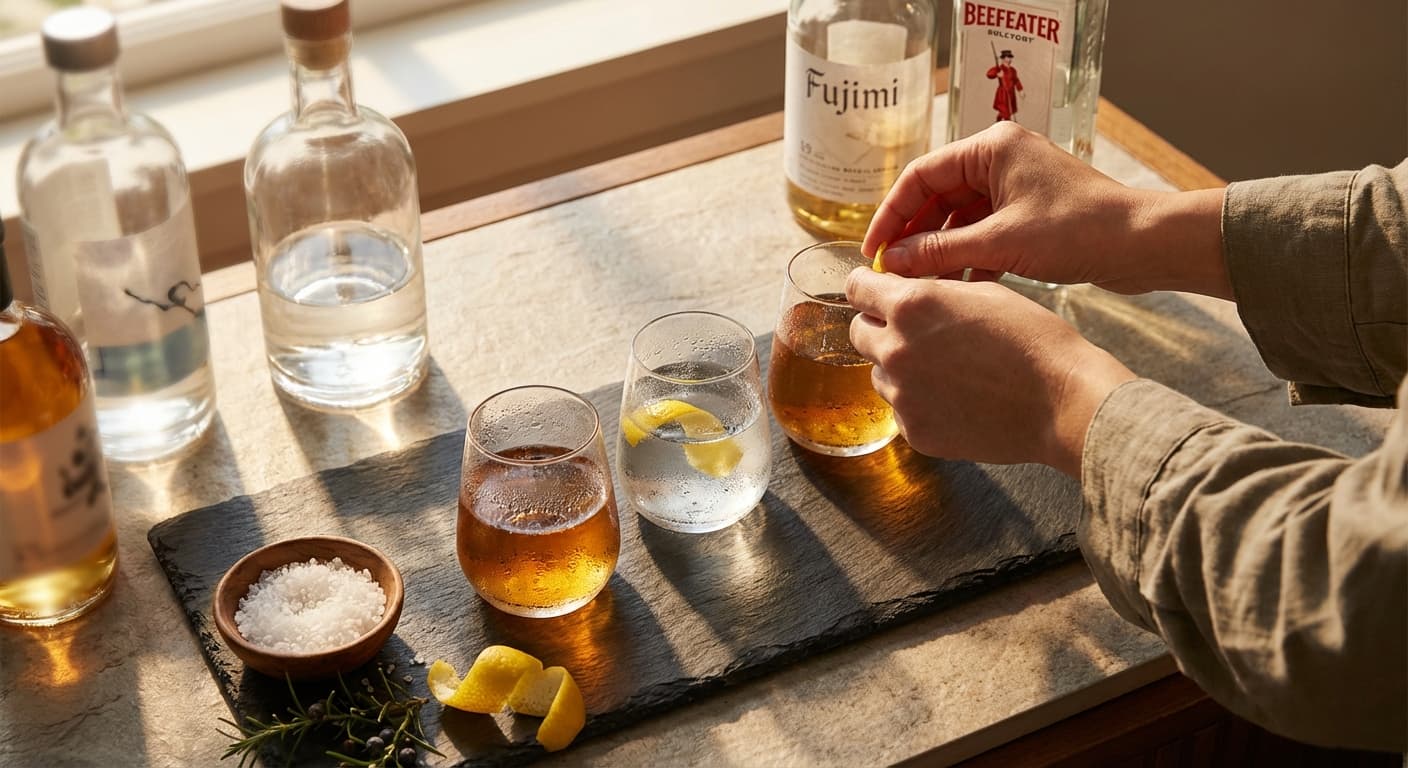
Beefeater London Dry Gin is one example of this category. At 40 percent alcohol and with a traditional, balanced profile, it suits a summery gin and tonic just as well as a dry Martini on a February evening. The advantage of such a classic is that it never surprises you negatively – it knows what it is, and it does the job.

Whisky gives you warmth and weight. Here you need one versatile blended whisky for highball drinks and one that can be enjoyed neat. Japanese whiskies have in recent years proven themselves as excellent compromises – round, approachable, but with enough complexity to be interesting on their own.
Fujimi Blended Japanese Whisky delivers exactly that. 40 percent alcohol, balanced between honey and light spice, it works both in a Highball with ice and soda – and neat, with a couple of drops of water. It is the whisky you can put out without worrying about what your guest prefers.
A third bottle of whisky could be a more characterful variant – perhaps a smoky Islay or a more powerful single malt – but that comes in the second round. First: what works for everything.
Sweet, bitter, sharp: flavours you can't mix your way to
The next layer is about filling flavour gaps. A good vermouth – ideally both red and white if you have room – gives you access to Negroni, Manhattan, Martini. A bitter liqueur like Campari, Aperol, or Suze adds the bitter dimension that many modern drinks rest on.
Then: something sweet and something sharp. An apricot brandy or Cointreau for Margarita and Sidecar, and a simple vodka that disappears into whatever you want it to disappear into. Vodka sounds boring, but when someone wants a Moscow Mule or just something light and refreshing with citrus, it's there.
These bottles are not the heroes. They are the supporting cast around the main characters. But without them, the show grinds to a halt.
The Nordic wildcard: aquavit
Aquavit is the card many forget, but one that opens more doors than you might think. It's not just for pinnekjøtt. Mixed with apple juice, honey, and lemon it becomes a Nordic twist on a Whisky Sour. In a classic Old Fashioned recipe – bitters, a little sugar, ice – aquavit brings a caraway note that surprises.
Choose an aquavit with moderate barrel or spice tones, not the very heaviest aged varieties. You want something that plays along, not takes over. Meir Original Aquavit is a good example – 40 percent alcohol, caraway and anise in balance, and a mildness that makes it versatile both neat and in drinks.

What you actually need in addition
Bottles are not enough. Without the right tools and ingredients you're no further along. Here is the list that should always be on hand:
- Fresh lemon and lime. Not fresh = not worth making.
- Simple syrup (equal parts sugar and water, bring briefly to a boil and cool). If you make it yourself you won't have to go looking for it.
- Angostura bitters. That one bottle lasts for years.
- Ice, and plenty of it. Bad ice ruins more than bad spirits. Freeze water in large moulds if you want big ice cubes for an Old Fashioned.
- A shaker, a bar spoon, a strainer. Three tools. That's genuinely all you need.
Add a sharp knife, a cutting board, and a citrus press, and you're done. The rest is decoration.
Three drinks that test your bar
A good home bar should be able to handle these:
1. Gin & Tonic
The simplest test.
Ingredients:
- 5 cl gin
- 15 cl tonic (quality matters here)
- Lemon peel or a sprig of rosemary
- Plenty of ice
Method:
- Fill a tall glass with ice.
- Pour gin over the ice.
- Top up gently with tonic.
- Squeeze the lemon peel lightly over the glass, drop it in.
- Stir once, gently.
Nothing should be lukewarm. This is the drink that reveals whether you have the basics under control.
2. Whisky Highball
Ingredients:
- 5 cl whisky
- 10 cl soda (Fever-Tree Ginger Ale, or plain sparkling water)
- Ice
Method:
- Fill a tall, narrow glass with ice.
- Pour over the whisky.
- Top with soda.
- Stir once.
Done. This is the Japanese everyday drink – elegant, simple, refreshing. It shows that whisky doesn't have to be heavy and ceremonious.
3. Old Fashioned
Ingredients:
- 6 cl whisky (or aquavit)
- 1 teaspoon simple syrup
- 2–3 drops Angostura bitters
- Orange peel
- Large ice cube
Method:
- Pour simple syrup and bitters into a solid whisky glass.
- Stir together.
- Add the ice.
- Pour over the spirits.
- Stir for 20 seconds.
- Twist the orange peel over the glass, run it around the rim, drop it in.
This is the drink that demands patience. Stir too little, and it becomes unbalanced. Stir too much, and it becomes watered down. But when you get it right, it's magical.

The bar that grows with you
The great thing about this approach is that it allows for evolution. Once you have mastered the eight bases, you add a bottle of mezcal for smoky depth. A Chartreuse for herbal complexity. A sherry for drinks at the intersection of wine and cocktail.
But start here. Eight bottles that talk to each other, that give you the freedom to improvise, and that – most importantly – are out on the shelf because you actually use them.
That is the difference between a collection and a bar. A collection is something you show off. A bar is something you use. And a bar you use is a bar that lives – it changes, adapts, grows with your taste and the seasons.
So the next time someone asks what they should have in their home bar, the answer is simple: Start with eight bottles. Get to know them. The rest takes care of itself.