
We've all been there: A lovely bottle is opened for dinner, but only a couple of glasses are poured. The next day the wine tastes flat and dull. Three days later? Downright unpleasant. But with the right technique, you can actually keep opened bottles fresh for up to a month.
Here is the complete guide to storing wine at home – from cheap tricks to professional solutions.
The enemy you can't see
Oxygen is like an overeager dinner guest – pleasant at first, but destructive if allowed to stay too long. When you remove the cork, an oxidation process begins that gradually breaks down the fruit flavors and transforms the wine into something that resembles vinegar more than drinking pleasure.
Think of it like a sliced apple turning brown – the same principle, just more complex.

But the speed of this process varies enormously. A light, fresh white wine can be done in two days, while a robust red wine easily lasts a week. And with the right equipment? Then we're talking weeks, not days.
I've tested all the methods over the years – both at work and at home. Some are pure placebos, others are genuinely revolutionary. Let me walk you through the three that actually work.
Method 1: The vacuum pump (10–70 kroner)
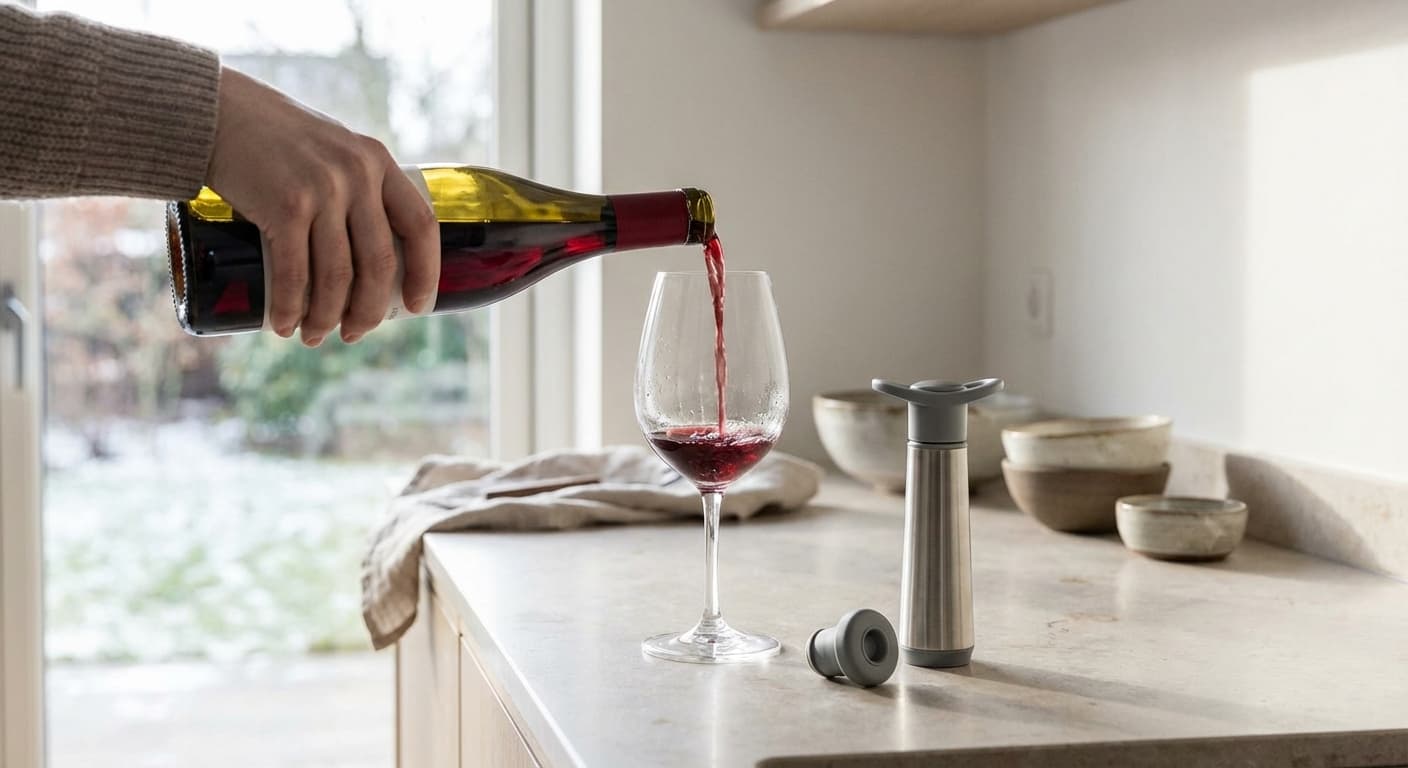
The simplest solution is also the cheapest. A vacuum pump with rubber stoppers sucks air out of the bottle and creates a partial vacuum. It's like giving the wine a small pressure chamber.
How to do it:
- Place the rubber stopper in the bottle neck
- Pump until you feel resistance (usually 10–15 strokes)
- Store the bottle somewhere cool and dark
Stays fresh: White wine 3–5 days, red wine 5–7 days.
The limitation: You never remove all the air, just most of it. And the rubber stoppers can leak over time. But for everyday use at under a hundred kroner? Brilliant.
I have one lying in my kitchen drawer that has saved countless bottles from ending up down the drain. It's not perfect, but it does the job for 90 percent of situations.
Method 2: Argon gas systems (200–400 kroner)
Now we're moving into semi-professional territory. Argon gas is an inert, heavier-than-air gas that settles like a protective blanket over the wine. It's like giving the bottle an invisible duvet.
How to do it:
- Spray 2–3 seconds of argon gas down into the bottle
- Replace the original cork or a silicone stopper
- Store the bottle upright (important!)

Stays fresh: White wine 7–14 days, red wine 14–21 days, fortified wine up to 30 days.
The bonus: Perfect for sparkling wine. Yes, you read that right. A prosecco with argon gas and a proper sparkling wine stopper keeps the bubbles for 3–5 days. Try it with a light and fresh Albino Armani Prosecco – it already has slightly lower pressure than Champagne, so it handles re-opening better.
This is my personal favorite for everyday use. One canister of gas lasts for 50–100 bottles, and you don't have to pump like crazy. Just spray, cork, done.
Method 3: Coravin (2000–4000 kroner)
The wine world's iPhone. The Coravin system inserts a thin needle through the cork, draws out wine, and replaces the volume with argon gas – without removing the cork. When the needle is withdrawn, the cork seals itself.
How to do it:
- Place the Coravin capsule on the bottle
- Insert the needle through the cork
- Press the button to release gas while you tilt and pour
- Remove the system – the cork is still intact
Stays fresh: Months. Yes, months. I have personally tested bottles after three months that taste almost like new.
The limitation: Price, of course. And it only works with natural cork – not screw caps or synthetic stoppers. But for collectors and enthusiasts? Revolutionary.
This is the tool that changed the way I drink wine. Suddenly I can open an expensive bottle on a Tuesday evening without feeling pressure to drink the whole thing. One glass today, one next week, one with dessert in a month. Magical.
The big timeline: How long does the wine last?
Without protection (just the original cork replaced):
- Light white wine: 1–2 days
- Full-bodied white wine: 2–3 days
- Rosé: 2–3 days
- Light red wine: 2–3 days
- Full-bodied red wine: 3–5 days
- Sparkling wine: 4–6 hours (yes, hours!)
- Fortified wine (sherry, port wine): 7–28 days (higher alcohol protects it)

With a vacuum pump:
Add 2–3 days to the figures above.
With argon gas:
Double to triple the lifespan.
With Coravin:
Practically unlimited for still wine with natural cork.
These figures are based on experience from hundreds of bottles. But remember: There are always individual variations. A robust Barolo can take more than a delicate Pinot Grigio. Use your nose and your palate as the final judge.
The signs that a wine is done
Your body knows before your head does. Here are the classic warning signs:
The smell: Wet cardboard, vinegar, nail polish remover, or rotten apple. If it smells off, it's gone bad.
The color: White wine that turns deep golden or brownish. Red wine that develops a sad, brown-orange rim. It's like the difference between a fresh salad and one that's been left out too long.
The taste: Flat, sour, metallic, or simply stripped of fruit. The part that made the wine exciting – gone.
But: A little aeration can actually be good for heavy red wines during the first 24 hours. So don't throw the bottle away in a panic the day after – taste it first.
I've seen people throw away perfectly good bottles because they thought the wine had gone bad after one day. At the same time, I've seen people drink wine that should have been poured down the drain a week ago. Learn the signs, and you'll avoid both mistakes.
My three golden rules
1. The refrigerator is your friend
All wines, including red wine, keep better when cold. The cold dramatically slows oxidation. Take the red wine out 30 minutes before serving, and the temperature will be perfect.
This is perhaps the most important trick of all. Even without any fancy equipment, you can double the shelf life simply by storing the bottle in the refrigerator. I do it with absolutely every opened bottle, regardless of color.
2. Smaller bottle = longer life
If you have a lot of wine left, pour it into a smaller bottle (e.g. a half bottle). Less air = less oxygen = longer shelf life. Household science that actually works.
I have a collection of empty half bottles sitting in the cupboard just for this purpose. It might look a little odd, but it works.
3. Prioritize the order
Drink light white wine and rosé first, then red wine, and save fortified wine for last. Port wine and sherry can last weeks even without any aids, thanks to their higher alcohol and sugar content.
If you have three open bottles in the refrigerator – a Sauvignon Blanc, a Chianti, and a tawny port – you now know which one to reach for first.
What is worth the investment?
For most people: Start with a vacuum pump. It costs as much as a beer at dinner and makes a big difference.
Do you drink several bottles in parallel, or like to try expensive wines glass by glass? An argon gas system is the answer. One canister of gas lasts for 50–100 bottles.
Are you a wine collector with bottles costing over a thousand kroner? Coravin pays for itself after three bottles.
I use all three methods at home, depending on the situation. Vacuum pump for everyday wines, argon gas for sparkling wine and mid-range bottles, Coravin for the truly special ones. It's not either-or – it's a toolkit.
The ultimate preservation method
And remember: The best preservation method is always to share the bottle with someone you like. The wine may not last forever, but the memories do.
After fifteen years in the restaurant industry, I've learned that the best wine experiences rarely have anything to do with perfect storage or the most expensive equipment. They're about sharing something good with someone you care about, at exactly the right moment.
But when the moment isn't right for the whole bottle? Then it's good to know that the wine is waiting for you – fresh and ready – when you're ready for the next glass.
Cheers – and happy storing!