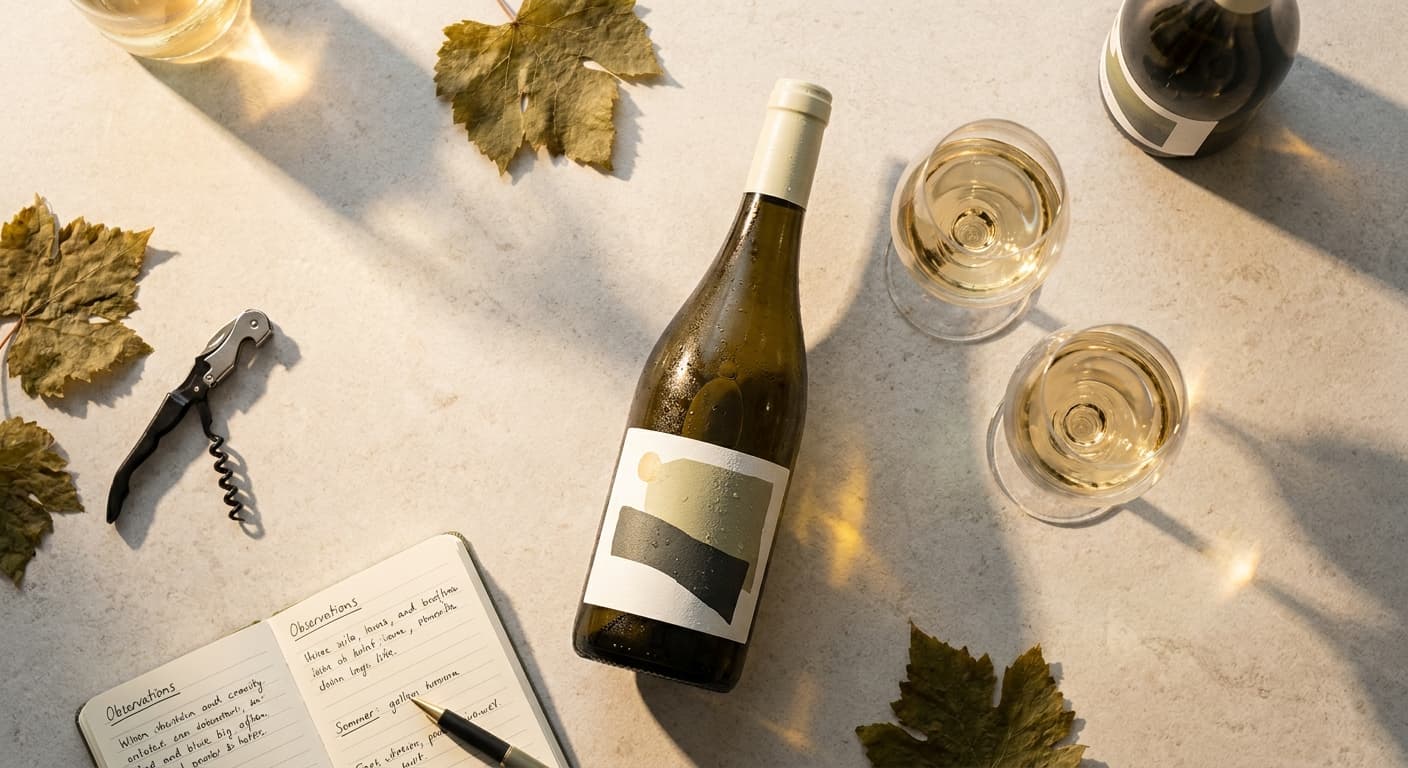

There's a little trick that experienced wine drinkers use before they even lift the glass to their lips: they look at the color. Not to be snobbish, but because the color actually tells you something. It's the wine's calling card – a small window into how the wine was made, how long it has lived, and what you can expect to taste.
So let's decode that code, step by step.
Nearly Colorless to Pale Yellow – Freshness in the Bottle

When you hold a glass up to the light and the wine looks almost like water – perhaps with a faint greenish tint – you're in the territory of freshness. This is typical of young wines made from grape varieties such as Riesling, Sauvignon Blanc, Muscadet, and Vinho Verde.
The greenish tint comes from chlorophyll in the grape skin and is a sign that the wine is young and that the grapes were harvested early. In terms of taste, you can expect high acidity, light citrus aromas, and fresh, herbaceous notes – think grass, lime, and green apples.
A good example here is Pluma Vinho Verde Branco 2025 – a wine that is almost water-transparent in the glass with a thin, white-green rim. With just 9% alcohol, it's light as a feather, and pairs perfectly with seafood or as an aperitif on a warm spring evening out on the terrace.
Another classic in this category is Nahetal Rüdesheimer Rosengarten Riesling Feinherb 2024, which with its 10% alcohol and pale color signals exactly that: light, fresh, with a little residual sweetness that balances the acidity nicely. Feinherb means off-dry in German, and that slight sweetness makes it a dream with Asian food or simply on its own, with good company.
Straw Yellow and Pale Gold – The Classic White Wine
The most common color of a young, well-made white wine is a clear straw yellow – think the autumn sun hitting the straw in August. This color is no longer "almost nothing," but not overwhelming either. It's the midpoint, where most of us spend the majority of our wine lives.
Grape varieties such as Chardonnay, Pinot Grigio, and Chenin Blanc often fall into this range when they are fresh and without much oak aging. The aromas are richer than in the nearly colorless category – you'll often find yellow apples, peach, lemon, and flowers.
Gérard Duplessis Chablis 1er Cru Montmains 2022 is a good example. Chablis is Chardonnay without oak, and the color is often a mild straw yellow with green reflections. Fresh, mineral, with a slightly creamy texture reminiscent of chalk and oysters – and the color warns you of exactly this. Hold the glass up to the light and see the clear, pale yellow color, and you know you're in for something pure and precise.

Gold and Deep Gold – When Oak and Time Speak
This is where it starts to get really interesting. When a white wine approaches a warm, deep golden tone, it's usually one of two things that has happened – or both:
1. Oak aging. The wine has rested in oak barrels, which adds color, tannins, and aromas of vanilla, butter, toast, and spice. The longer the time in barrel, the deeper the gold.
2. Age. Over time, wine gradually oxidizes, and the yellow pigment from flavonoids in the grapes intensifies. A ten-year-old Chardonnay often looks golden even without oak.
Storm Wines Ridge Chardonnay 2023 from South Africa is a wine that often displays a warmer, golden-yellow color – a result of Chardonnay's naturally rich style combined with careful oak contact. Here you can expect aromatic richness: butter, ripe apple, cream, and a hint of vanilla. It's a wine that says "take your time" already in the glass.
At the more intense end you'll find wines like 1000 Stories Chardonnay from California – barrel-aged and with a full 14% alcohol. Deep gold in the glass, and the flavor matches: ripe fruit, caramel, oak, and a long, warm finish. Not for those who want easy-going freshness, but for those who want body and character. Think grilled chicken with butter sauce, or a good brie.
Amber and Orange – What's Going On Here?

If a white wine approaches an orange or brown amber color, it isn't necessarily wrong – but it does tell you something specific. Two scenarios:
Skin contact / orange wine: White grapes that have been in contact with the skin during fermentation, somewhat like red wine, yield extracted tannins and a deeper color. The aromas are often dried fruit, nuts, herbs, and an oxidative character. Giuaani Tsolikauri 2023 from Georgia is a fascinating example – a Georgian white wine made in the traditional kvevri style, where the grapes ferment in large clay vessels buried in the ground. The result is a naturally pale amber color, a complex aroma of quince, walnut, and dried apricot, and a texture that is much fuller than you'd expect from a white wine.
Oxidized or aged wine: If the color is brownish rather than amber, and the wine was meant to be young, it may mean the wine has been exposed to too much air. That doesn't necessarily mean the wine is ruined – many oxidative styles are intentional, such as sherry or Jura wines – but it's worth noting. A young Sauvignon Blanc that is brownish is probably not at its best.
A Practical Rule of Thumb
Here is the simple rule of thumb you can take with you the next time you choose a white wine:
| Color | What it often means | Typical taste profile |
|---|---|---|
| Nearly colorless/greenish | Young, early harvested, no oak | Citrus, freshness, high acidity |
| Straw yellow | Young to mature, little/no oak | Apple, flowers, balanced |
| Gold | Oak and/or age | Butter, vanilla, dried fruit |
| Amber-orange | Skin contact or oxidative style | Nuts, dried fruit, herbs |
The table is not a definitive answer – there are always exceptions. A young Viognier can be deep gold without a drop of oak, because the grapes themselves are so rich in pigment. But as a starting point, it holds up well.
Light Gives You Answers – Use It
The next time you open a bottle, hold the glass up to a window or a lamp. Look at the rim of the wine – the thinnest part where wine meets glass. That's where color nuances are most visible. A young wine often has a greenish or white rim. An older wine often has a golden or even slightly brown rim.
You don't need a sommelier's diploma or fancy glassware to do this. Just a little curiosity and a window.
And that's what's so enjoyable about wine: the more you learn to see, the more it gives back to you – even before you take the first sip.