
It's Friday evening, you're ready with the recipe for a perfect Negroni, and then you discover the gin is empty. In the cabinet, however, sits a half-full bottle of aquavit. Can you swap? Absolutely. But for the result to be just as good – or perhaps even better – there are some ground rules to follow.
I've spent years behind the bar experimenting with substitutions, both out of necessity and curiosity. The fascinating thing is that when you understand why a drink works, it suddenly becomes obvious what you can swap out. Let me share the principles that allow you to improvise with confidence.

Taste profile trumps category
The first thing you need to forget is the idea that all gins are alike, or that whisky can always replace rum. Spirits are not defined by what's on the label, but by what's in the bottle. A botanically complex gin like Opihr Aromatic Bitters London Dry Gin has more in common with a spiced aquavit than with a clean, neutral gin.
Think instead in these dimensions:
- Botanical/herbal vs. clean/neutral: Gin and aquavit often belong to the same family, while vodka stands alone at the clean end
- Sweet vs. dry: Rum and whisky can vary enormously – a dark, spiced rum has little in common with a light agricole rum
- Smoky vs. mild: Islay whisky and mezcal share a smoky character, even though they come from different worlds
- Strength: ABV affects the balance of the drink – a 40% vodka does not straightforwardly replace a 50% overproof rum
When you think in taste profiles instead of categories, a whole universe of possibilities opens up. A spiced aquavit can work in a drink that really calls for spiced rum. A mild, grain-based vodka can replace a light gin in certain contexts. It's about matching the function, not the label.

When aquavit replaces gin
This is perhaps the most exciting substitution for us in the Nordics. Both gin and aquavit are botanically driven spirits, but where juniper dominates in gin, caraway and spices take over in aquavit. The key lies in matching the intensity.
A classic Martini can absolutely be made with aquavit instead of gin – in fact, the result is often called a Nordic Martini. But choose an aquavit with a balanced spice profile. Jærakevitt Original or Litlestøl Sirdal Akevitt work excellently here. They have a clear character without overwhelming the vermouth.
The rule of thumb: If the recipe calls for London Dry gin (dry, juniper-driven), choose a clean, classic aquavit. If the recipe uses a spiced or botanical gin, you can go for a more distinctive aquavit like Ægir Ilmur Dill Akevitt with its dill notes.
Drinks that work particularly well:
- Tom Collins → Aquavit Collins (citrus balances the spice perfectly)
- Gimlet → Nordic Gimlet (the lime acidity cuts right through)
- Aviation → Nordic Aviation (here aquavit actually lifts the crème de violette)
- Negroni → here you need to be careful; aquavit can overpower the Campari. Test with smaller amounts first.
Wintertime is perfect for experimenting with aquavit in drinks. The warm spice notes fit naturally with the season, and when you come in from the cold with a Nordic Collins in hand, you suddenly understand why our ancestors appreciated caraway and anise.
Rum to whisky – when it works and when it doesn't
This is harder because rum and whisky are produced so differently. Rum starts with sugarcane, whisky with grain. But in cocktails we often look for similar functions: body, sweetness, warmth.
In an Old Fashioned you can swap rum for a robust, full-bodied whisky – but choose one with a little sweetness. A Scottish blended whisky often works better than dry single malts here. Glenwood Blended Scotch Whisky is a sensible choice for this kind of experiment – it has enough character to hold its own against bitters and sugar, but not so much that it dominates.
In a Mojito, though? Forget it. White rum's light, slightly sweet profile has no counterpart in the whisky world. Here vodka is a far better alternative if you absolutely must swap – Zubrówka Biala Vodka actually gives an interesting twist with its clean, Polish character.

The exception is Tiki drinks. Dark rum in a Mai Tai or Zombie can be replaced with a robust whisky, particularly one with sherry cask maturation. But be prepared for the drink to become more grown-up and less tropical. Nikka From The Barrel, at 51%, can actually work surprisingly well in a modified Tiki drink – but then we're talking winter version, not beach bar.
Vodka – the difficult blank canvas
Vodka is the paradox. It's designed to be neutral, so in theory it should be the easiest to replace. But precisely because it adds no flavour, it becomes the hardest to swap out without the drink changing character.
In an Espresso Martini you can use a mild whisky or rum instead of vodka, and many will say the result is better. The spirit lifts the coffee instead of merely providing alcohol strength. Here even a clean vodka like Roberto Cavalli Vodka can be swapped for something more characterful.
But in a Moscow Mule? Vodka is there to let the ginger beer shine. Swap to gin, and you get a Gin Buck. Swap to aquavit, and you get something entirely different. Not bad, but no longer the same drink.
A good rule of thumb: If the drink has few ingredients and vodka is the main component, it is hard to replace. If vodka is just one of many elements, you can experiment freely.
The three golden rules
After hundreds of experiments, I have three principles that always hold:
1. Match the intensity: Consider flavour and alcohol strength separately. Replacing 5 cl of a 40% spirit with about 3.9 cl of a 51% spirit gives the same amount of pure alcohol. That does not guarantee the same taste; adjust the rest of the drink carefully.
2. Respect the balance: Classic drinks are built on the balance between sweet, sour, strong and bitter. If you swap the spirit, you may need to adjust the other components. A more spiced spirit may need a little more citrus or sweetener. An aquavit with a strong caraway profile may require an extra half centilitre of simple syrup to balance.
3. Know the soul of the recipe: A Daiquiri is about rum, lime and sugar in perfect harmony. Swap the rum, and you have to re-balance everything. A Whisky Sour, on the other hand? It can handle swapping bourbon for rye, scotch or even aquavit, because the structure is more robust. Ask yourself: What is the core of this drink? If the spirit is the core, be careful. If it is one of several equally weighted components, experiment freely.
Practical example: Nordic Sour
Let me give you a concrete recipe that shows how the art of substitution works in practice. This is a classic Whisky Sour structure, but with aquavit:
Ingredients
- 5 cl aquavit (try Røros Akevitt or Averøy Akevitt)
- 2.5 cl fresh lemon juice
- 2 cl simple syrup (1:1)
- 1 egg white (optional, for foam)
- 2 dashes Angostura bitters
Method
- Dry shake (without ice) all ingredients for 10 seconds if using egg white
- Add ice and shake vigorously for 15 seconds
- Strain into a chilled coupe glass
- Drop bitters onto the foam and create a pattern with a cocktail pick
- Garnish with dried orange peel
This is a classic Whisky Sour structure, but with aquavit. The caraway plays against the citrus in a way bourbon never would. It's not better or worse – it's different, and equally balanced. The orange peel in the garnish is critical here; it adds an ethereal, oily note that binds the caraway and citrus together.

When you shouldn't swap
Some drinks are built so precisely around one spirit that substitution becomes meaningless. A Martini with vodka instead of gin is not a bad Martini – it's a Vodka Martini, a drink in its own right. A Margarita with whisky is not a Margarita, it's a Whisky Sour with triple sec.
Be honest with yourself: if you swap out more than the main ingredient, you're making a new drink. That's perfectly fine, but don't call it by the original name. Respect the classics enough to admit when you've created something new.
There are also some combinations that simply don't work. Aquavit in a Piña Colada? No. Whisky in a Caipirinha? Absolutely not. Sometimes the best choice is simply to wait until you have the right ingredient.
Final words
The finest thing about mastering the art of substitution is the freedom it gives you. You are no longer bound by what the recipe says – you understand why it says it, and can therefore improvise intelligently. Next time the gin is empty and the aquavit bottle is waiting, you'll know exactly what to do.
And if anyone asks whether it's allowed? Say that the bartender's most important tool is not the shaker, but the ability to taste with your head. The rules are there to help you, not to limit you. Start with the classics, understand why they work, and build from there.
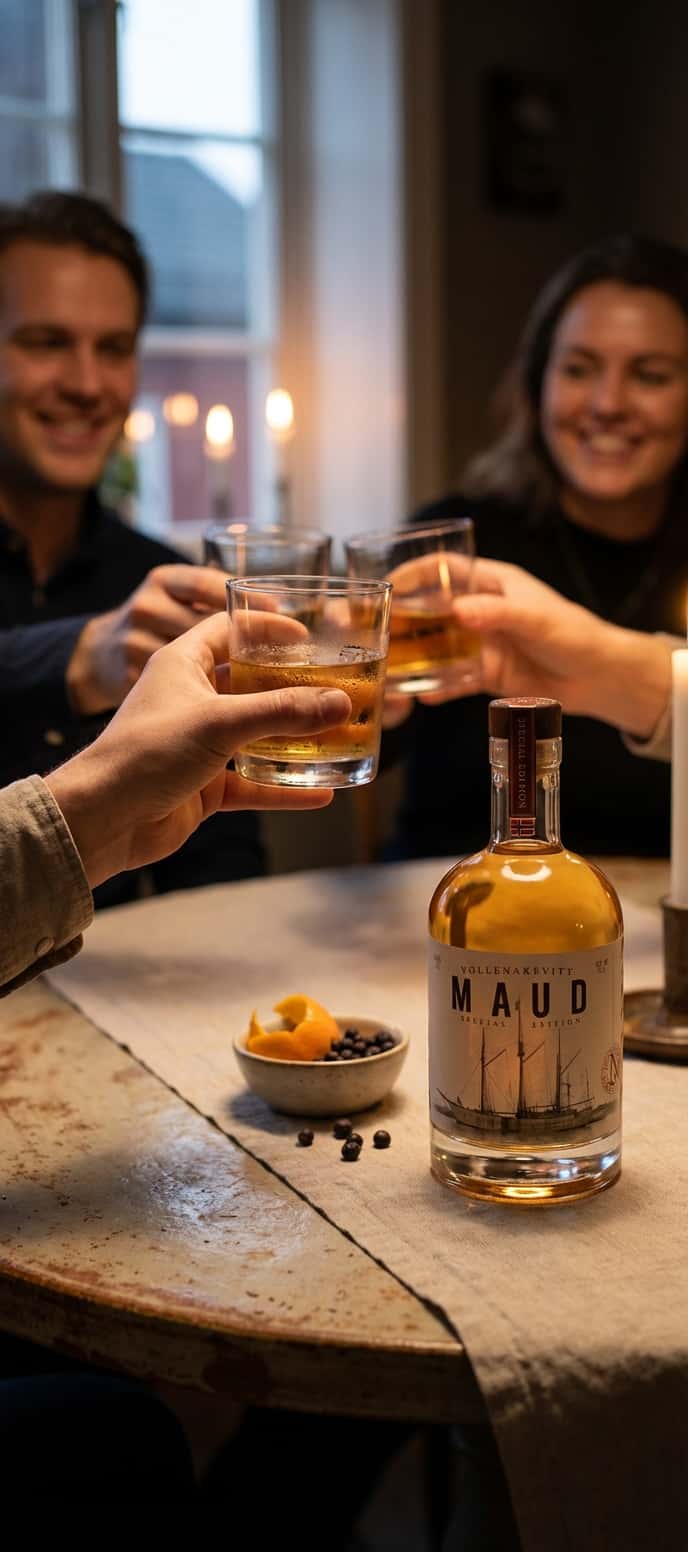
Wintertime is perfect for this kind of experimenting. When the darkness falls and the temperature drops, there is something deeply satisfying about standing in the kitchen and discovering that Vollen Akevitt Maud actually lifts an Aviation to new heights. Or that Averøy Akevitt in a Collins is exactly the glass you need after a day in the winter cold.
Cheers to curiosity, and to the bottles waiting to become something more than they were meant to be.