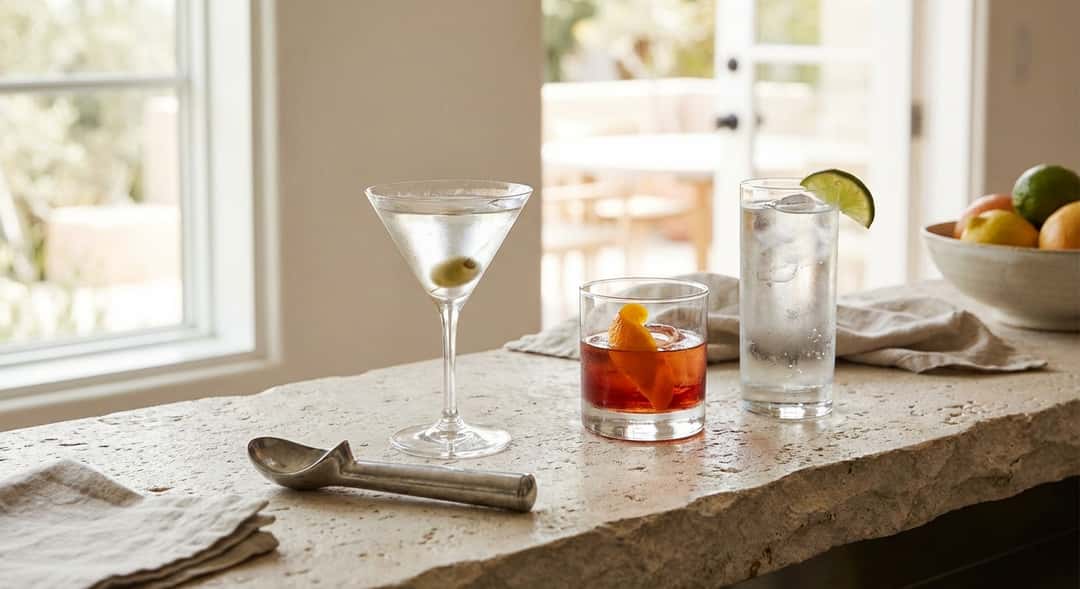

Last Saturday, friends showed up without warning. The shaker was drying on the rack, and I suddenly realized that half of the home bar doesn't actually need it at all. With an ice cream spoon from the drawer and three minutes per drink, I served three different cocktails that were actually better for not being shaken into a froth.
The story of stirring rather than shaking stretches all the way back to 19th-century bartenders, who knew that certain drinks required silky-smooth texture over airy bubbles. Martini, Negroni, and Old Fashioned – all the classics that contain only spirits and perhaps a little sugar or bitters – are stirred gently with ice until they reach the perfect temperature and dilution. The result? A smooth, cold drink without air bubbles that disrupt the balance.

When should you stir?
The rule is simple: if the cocktail only contains alcohol (and perhaps sugar, bitters, or aromatics), stir it. Juice, egg, cream, or milk? Then you need to shake. The reason is physics – shaking emulsifies ingredients that would otherwise not combine, while gentle stirring preserves the clear, heavy texture of spirits.
For spring's light evenings, you don't need drama in the shaker. Three simple, stirred cocktails with ordinary kitchen equipment:
1. Spring Martini with yuzu
A classic Martini gets a fresh, Japanese-inspired kick when you swap out the olive for a slice of yuzu or a spritz of yuzu juice. Yuzu – the citrus fruit that tastes like lime meets grapefruit – has become readily available in Asian stores, but you can also use a gin that already has yuzu in it.
Ukiyo Yuzu Gin combines traditional Japanese distillation with a rice base and this very citrus fruit, and works perfectly as the base in a Martini where you let the yuzu note shine through without extra additions. At 40% alcohol and with an elegant balance between citrus and juniper, it gives a Martini that feels both classic and modern.
Ingredients:
- 6 cl gin (preferably with yuzu notes)
- 1 cl dry vermouth
- Ice
- Lemon peel for garnish
Method:
- Fill a tall glass or pitcher with ice.
- Pour gin and vermouth over the ice.
- Stir gently with an ice cream spoon for 30 seconds – you'll feel the glass go cold against your hand.
- Strain into a chilled cocktail glass (put it in the freezer for 10 minutes first).
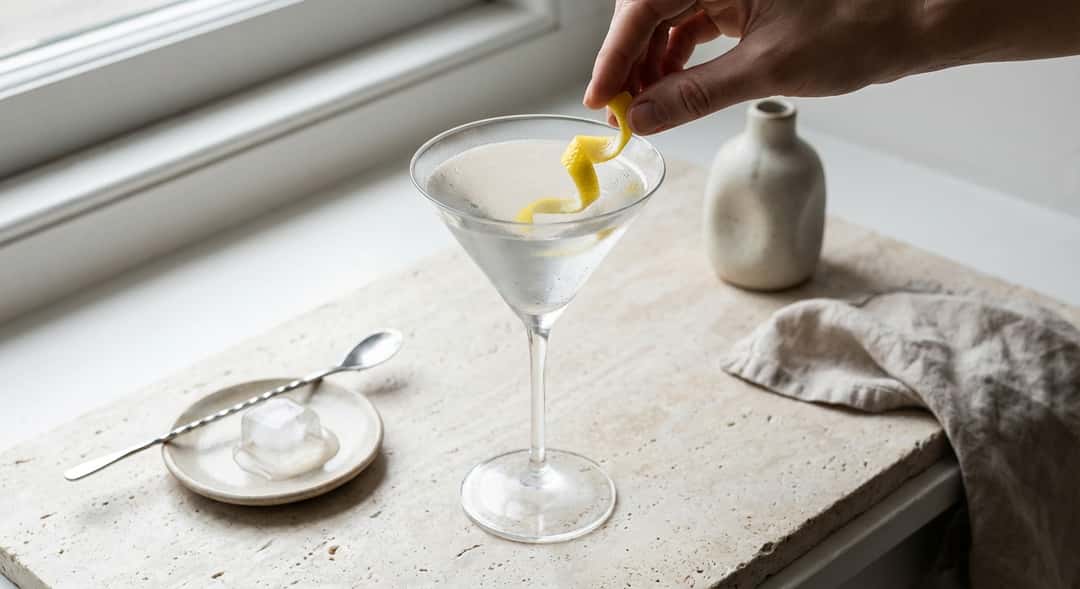
- Twist a lemon peel over the glass and drop it in.
Never stir too long – the drink will become watered down. 30 seconds is enough to chill and achieve the right texture. You'll notice the drink becomes silky smooth and cold, without the foamy surface that comes from shaking.
2. Simple Negroni with a Nordic twist
Negroni is the 1920s' gift to bartenders who want to keep things simple – equal parts gin, red vermouth, and Campari. But you can swap Campari for a Norwegian or Nordic bitters for a darker, more herbal tone.
Original Dr. Nielsen's Bitter, a Danish classic with roots dating back to 1888, gives a slightly rounder, less aggressive bitterness than Campari. At 38% alcohol and with a complex herbal profile, it works brilliantly in a Negroni where you want balance over punch. The Nordic approach gives a drink that feels more cosy and homely than an Italian piazza – perfect for spring evenings on Norwegian terraces.
For the gin, a classic London Dry holds up best. Tanqueray London Dry Gin with its 43% and distinct juniper berry notes provides the backbone a Negroni needs without overpowering the other ingredients.
Ingredients:
- 3 cl gin (a classic London Dry holds up best)
- 3 cl red vermouth
- 3 cl bitters (Campari or a Nordic alternative)
- Ice
- Orange slice for garnish
Method:
- Pour all ingredients directly into a short tumbler glass filled with large, coarse ice (the larger the ice, the slower it melts).
- Stir gently with an ice cream spoon for 20 seconds.
- Place a thick orange slice on top.
Negroni is always served in the glass you stir it in – no straining, no extra fuss. Perfect for a late afternoon on the terrace when the spring sun has finally warmed things up. The bitter, sweet balance is like a grown-up aperitif that awakens the appetite before dinner.

3. Spring's Gin & Tonic – the stirred version
Gin & Tonic needs no introduction, but most people don't know that you get a more elegant drink by stirring it rather than just pouring and hoping for the best. The technique is called "building", and means that the gin and tonic actually mix properly.
Choose a Nordic gin with fresh botanicals for spring. Skagerrak Nordic Dry Gin from Stavanger has seaweed, juniper, and citrus – all notes that lift when you let gin and tonic mingle together for a few seconds with ice. At 44% alcohol, it has enough strength to hold its own against the tonic without disappearing.
Ingredients:
- 5 cl gin (preferably with fresh, Nordic notes)
- 15 cl good tonic (premium tonic with low sugar)
- Ice (preferably large ice or ice cubes you've frozen yourself)
- Herb garnish: rosemary sprigs, thyme, or cucumber slices
Method:
- Fill a large highball glass all the way to the rim with ice.
- Pour gin over the ice.
- Stir gently for five seconds with an ice cream spoon.
- Pour tonic along the edge of the glass (not straight in – this retains more carbonation).
- Stir once, slowly, from bottom to top.
- Add herb garnish.
The secret lies in that first stir with just gin and ice – it chills the gin perfectly before the tonic hits, and you get a drink that tastes more balanced and less like "fizzy chaos". The tonic blends evenly throughout the entire glass instead of floating on top like a layer.

The ice cream spoon as a professional tool
An ordinary ice cream spoon – preferably one with a long handle – works as an excellent bar spoon. It has enough length to reach the bottom of tall glasses, and the flat spoon lets you stir without creating unnecessary turbulence. The technique is simple: hold the spoon between thumb and index finger, let it glide along the inside of the glass in a calm, circular motion. The goal is to mix and chill – not to whisk.
You'll notice the difference immediately. Stirred cocktails have a weight and texture that shaking can never provide. They feel more grown-up, more refined – like something you'd get at a proper bar, not a student party. And the best part? No washing up of shakers, strainers, and lids. Just a spoon that can go straight in the dishwasher.
When spring calls for simple rituals
These three drinks take under ten minutes in total to make, and none of them leave you with a shaker full of ice remnants to wash. They are perfect for spring's light evenings – when you want something more than beer, but can't be bothered with a full bartender project.
The Martini works as an aperitif before dinner, the Negroni is the perfect transition between afternoon and evening, and the Gin & Tonic is always right when the sun finally warms things up. All three share the same philosophy: good spirits, the right technique, minimal fuss.
Next time friends show up unannounced, you're ready with a bar that works at ice-cream-spoon level. And when they ask how you managed such smooth, perfect cocktails without a shaker, you just smile and say: "The secret is not to do too much."