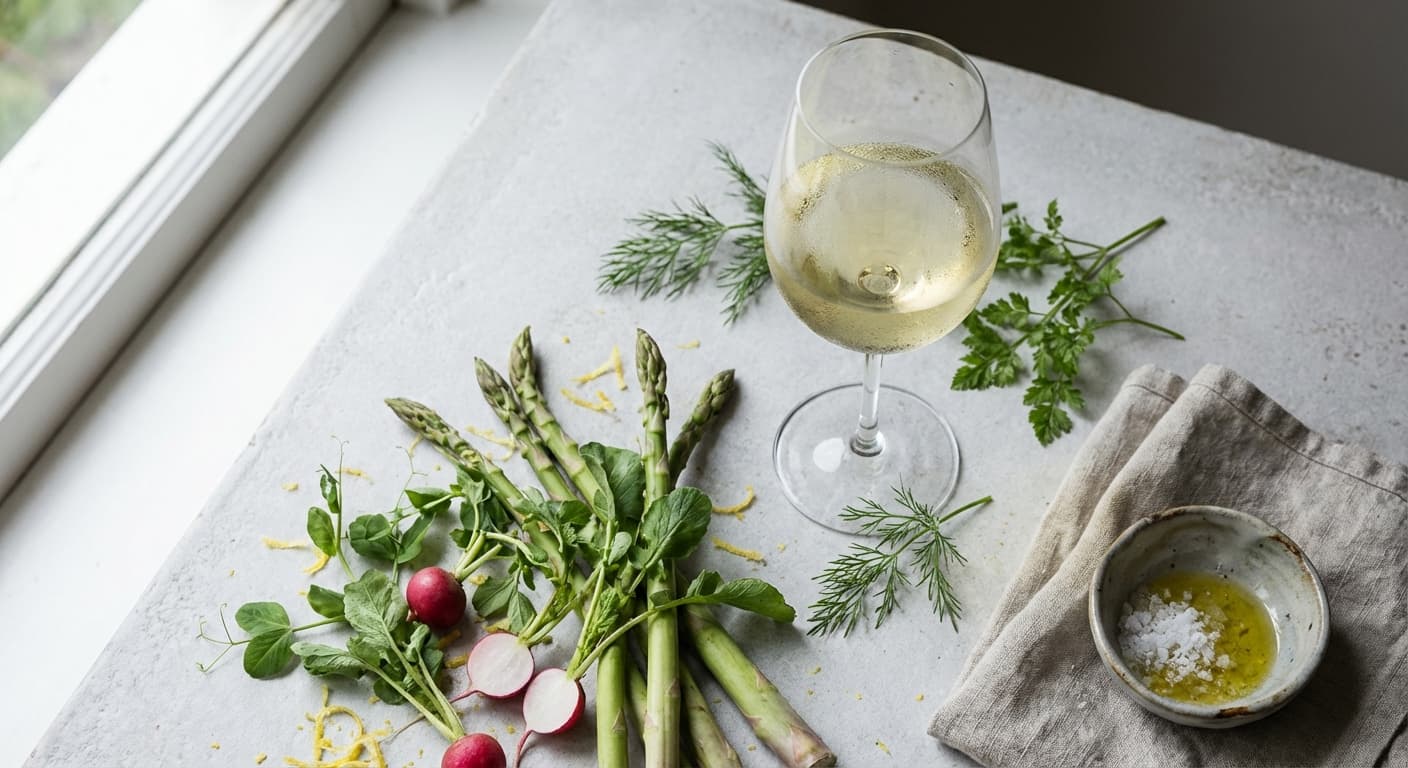

March is the month when the vegetable aisle finally starts to look like something other than a prepper friend's storage cellar. Asparagus, peas, sugar snap peas, spring onions – all the crisp and green things that make you feel like a better person just by filling your shopping cart.
But here's the point: these vegetables need a certain type of wine. Not just any white wine. They need acidity.

Why acidity is the key
Spring vegetables have something in common: they are packed with plant proteins, chlorophyll, and a certain bitterness that makes them difficult to match with wine. Try drinking a full-bodied, barrel-aged Chardonnay with an asparagus salad, and you will quickly discover that the wine tastes like wet cardboard.
The solution? Acidity.
A white wine with good acidity cuts through the plant bitterness, lifts the vegetables' natural sweetness, and ensures that your palate resets between each bite. That is why a crisp Riesling or a mineral Chablis can make even the most assertive asparagus taste like a delicacy.
Remember this rule of thumb: the greener the vegetable, the more acidity you need in the glass.
Three concrete matching principles
1. Steamed and simply prepared = mineral wine
When you steam asparagus or blanch peas with a little butter and salt, you need a wine that is equally pure. Here we are talking about unfiltered, cool white wine districts: Chablis, Muscadet, German Riesling.
La Manufacture Benjamin Laroche Chablis 1er Cru Vau Ligneau 2023 is an example of a wine that understands the task. Classic Chablis minerality, crisp acidity, zero oak. It costs around 230 kroner and does the job alongside asparagus with hollandaise without stealing the show.

2. Sautéed and caramelized = a little body, still acidic
When you sauté sugar snap peas over high heat or grill asparagus with olive oil until they get char marks, you need a wine with a bit more body – but still with backbone in place.
German Rieslings from the Pfalz or Rheinhessen deliver here. Philipp Kuhn Steinbuckel Riesling Trocken GG 2023 comes in at around 240 kroner and has the perfect balance: ripe stone-fruit sweetness that matches the caramelization, but a razor-sharp acidity that cleans up afterwards.
3. Herbs and citrus in the dressing = aromatic wine
If you make a salad with peas, mint, lemon zest, and feta cheese, you need a wine that speaks the same language. Here Sauvignon Blanc from cooler regions works, or white wine from the Loire.
Pépière Clisson Muscadet Sèvre et Maine 2022 is a bargain at 180 kroner. Muscadet is often overlooked, but this is a wine that loves green herbs. It has a saline mineral acidity that makes the feta sing.

When you want to spend a little more
If you are having guests and want to go all in, there are two wines here that take the spring vegetable meal to another level.
Ostertag Sylvaner Vieilles Vignes 2021 from Alsace costs around 200 kroner and is one of the most underrated wines for asparagus. Sylvaner is a grape variety that has been forgotten in favour of Riesling, but it has an herbal elegance and a phenomenal ability to match green vegetables. Old vines, biodynamic farming, zero spraying. It tastes like a forest floor in spring – in the best possible way.
Alternatively: Jakob Schneider Grauschiefer Riesling Trocken 2024 from Mosel, around 210 kroner. Grauschiefer means grey slate, and that is exactly what you taste: stone minerals, snapping acidity, and a kind of vibration in the wine that means it never becomes tiring. It handles both raw and cooked vegetables, and if you serve it cold (8–10 degrees), it can rescue even an overcooked asparagus.

How to serve it
Here is the simplest recipe for the best spring vegetable meal of the season:
Ingredients (4 people)
- 500 g green asparagus
- 200 g sugar snap peas
- 150 g fresh peas (frozen works too)
- 2 tbsp butter
- Salt and pepper
- Juice of half a lemon
- Fresh mint
- 100 g feta cheese, crumbled
Method
- Heat a frying pan to medium-high heat. Add half the butter.
- Sauté the asparagus until it gets a little colour, 3–4 minutes. Remove it.
- Add the remaining butter, sugar snap peas, and peas. Sauté quickly, 2 minutes.
- Combine everything, drizzle over lemon juice, salt, and pepper.
- Top with mint and feta.
- Pour the wine well chilled, sit outside if you can, and enjoy the fact that winter is over.
When it doesn't work
Let's be honest: some wines ruin spring vegetables. Avoid:
- Barrel-aged Chardonnay (butter + bitterness = no)
- Powerful, warm white wines from Southern Europe (too much alcohol kills the acidity)
- Sweet or off-dry wines (they amplify the bitterness)
Stick to cool districts, dry wines, and high acidity. Then you can't go too far wrong.
Why this works
It is all about balance. Spring vegetables have a delicate structure that is easily overwhelmed by heavy wines. At the same time, they have a plant bitterness that needs to be met with something that cuts through – not something that amplifies it.
Acidity is the only element in wine that can simultaneously lift sweetness, dampen bitterness, and create a sense of freshness. That is why a well-balanced Riesling or Chablis can make a simple asparagus taste as though it was picked in a Michelin garden.
It is also why you should serve these wines colder than you might otherwise. 8–10 degrees keeps the acidity sharp and the wine crisp. When the wine warms up, it loses the edge that does the job.

In summary
Spring is short in Norway. The weeks when asparagus actually tastes good are even shorter. So when you are standing there with a bunch in your hand wondering what to drink with it, you now know the answer: a white wine with acidity that cuts, lifts, and resets.
Stick to Chablis, Muscadet, German Riesling from cool districts, or Sauvignon Blanc from the Loire. Serve them cold. Avoid oak, avoid warm districts, avoid sweet wines.
Then you can't go too far wrong. And when you are sitting out there in the evening sun with a glass of Riesling and a plate of crisp, green vegetables, you will understand why some of us wait for March all winter.