
It's Friday evening, guests are arriving in an hour, and you suddenly remember that the white wines are still sitting out on the counter. Recognize that little pang of panic? Good. Then you're in the right place.
Serving temperature is one of the most underrated factors in the wine experience – and at the same time one of the easiest to do something about. Not because you need a thermometer around your neck, but because you need to understand what temperature actually does to the taste. As a former brewer, I know that temperature isn't just a number on a scale. It's a sensory layer in its own right.
What actually happens to the wine when it's at the wrong temperature?
Wine that's too cold closes up. The aromas disappear behind a kind of chilly wall, and you're left with acidity and little else. Have you ever tasted a Chablis straight from the fridge and thought "this is flat"? It's not the wine. It's the temperature.
Wine that's too warm does the opposite. The alcohol rises to the surface and dominates. A light, elegant Pinot Noir that should taste of strawberry and violet suddenly starts tasting of spirits and overripe cherries. That's not the wine you paid for.
The rule of thumb is simple: the lighter the wine, the colder it should be served. But let's get a bit more specific.

White wine: fresh, but not ice-cold
Correct temperature: 8–12 °C
A fresh, high-acid white wine like a Chablis needs to be properly chilled – around 8–9 °C – so that the acids feel lively rather than sharp. Laurent Tribut Chablis 2022 is exactly that kind of wine: mineral and crisp, with the characteristic chalky freshness from the Kimmeridge limestone. Cold enough to be refreshing, but not so cold that it loses its edge.
A fuller-bodied white wine, such as Louis Latour Bourgogne Chardonnay 2024, can be served a little warmer – closer to 11–12 °C – so that its rounded, buttery character can come into its own without the alcohol taking over. Here we're talking about a wine with moderate oak, giving hints of vanilla and a full-bodied mouthfeel. At the right temperature, it balances the fruit (citrus, apple) against the creamy texture.
Chilling time from room temperature (22 °C):
- Fridge (4–6 °C): approx. 2.5–3 hours
- Ice-water bath (ice + water): approx. 20–25 minutes
- Freezer: 15–20 minutes (no more – you risk the cork and expansion)
An ice-water bath is far more effective than ice alone, because water conducts heat better than air. Fill a bucket or sink with equal parts ice and cold water, submerge the bottle up to its shoulders, and turn it halfway through. It's the fastest way to chill without risking thermal shock.
Rosé: most of summer's lightness, served in a spring mood
Correct temperature: 9–11 °C
Rosé is perhaps the wine type most often handled incorrectly – either too cold (all the fruit disappears) or too warm (flat and cloying). A good spring rosé like Torre Beratxa Rosado 2024, with its pale colour and sharp berry acidity, is happiest around 10 °C. At that temperature it opens up with aromas of red grapefruit and fresh strawberries, without losing the nerve that makes it good.
This Spanish rosé is made from Garnacha, and it has the typical dry, almost saline finish that makes it perfect with shellfish, grilled vegetables, or a simple salad with feta and olives. But only if you serve it at the right temperature.

Practical tip: Put the rosé in the ice-water bath about 20 minutes before serving. Turn the bottle halfway through. An ice-water bath (equal parts ice and water) chills far faster than ice alone, because water conducts heat better than air.
Light red wine: the most misunderstood of all
Correct temperature: 13–16 °C
This is where the most mistakes are made. Room temperature is one of the wine world's most misused concepts. It originates from a time when European dining rooms were around 16–18 °C. In a modern Norwegian living room in April, with panel heaters and sun through the window, room temperature can easily be 21–23 °C. That's far too warm for a light Pinot Noir or a Bourgogne rouge.
A wine like Leroux Bourgogne Rouge 2023 is made to be silky and fruity, with delicate tannins and fine acidity. Serve it at 22 °C and that finesse disappears, leaving you with a warm, slightly limp drink. Serve it at 14–15 °C and it blossoms. You bring out the red berries, the discreet spice, and the elegant structure that makes Burgundy wines so sought-after.
The same applies to a wine like Joseph Drouhin Volnay 2022 – a classic Pinot Noir from one of Burgundy's finest villages. Volnay is known for its feminine, perfumed wines with tannins that melt on the tongue. But warm it up to 20 °C and you lose all that finesse. Chill it down to 14–15 °C and you have a wine that almost floats.

Chilling tips for red wine:
- 20–30 minutes in the fridge brings it down from room temperature to approx. 14–16 °C
- Using an ice-water bath: 8–10 minutes is enough for most light red wines
- Never the freezer for red wine – thermal shock can actually alter the taste profile
I've seen people put Pinot Noir in the freezer for 40 minutes and wonder why the wine tastes flat afterwards. Red wine doesn't tolerate sudden temperature changes the way white wine does. The aromas get shock-frozen, and even when the wine warms back up, they don't fully return.
The most common mistakes – do you recognise yourself?
1. Fridge set to 2–3 °C
Many fridges run colder than recommended, and after three hours inside, the wine is ice-cold. Taste it after ten minutes in the glass – it often opens up considerably. If you know your fridge runs particularly cold, take the wine out 15–20 minutes before serving and let it stand on the counter.
2. The freezer as an emergency solution
We've all done it. Just 15 minutes. But then we forget the bottle, and after 40 minutes you either have a partially frozen wine or a bottle with a cork that's pushing its way out. Set a timer. Always. I once lost a bottle of Chablis that way, and it was not fun.
3. The red wine that never gets chilled
The most common blunder. Especially in spring, when the living room is warm and the wine has been sitting in a room at 20 degrees. Light red wine – Gamay, Pinot Noir, light Grenache – should be chilled a little. It's not blasphemy, it's respect for the wine. Think of it like serving beer at the right temperature: nobody wants a lukewarm lager, and nobody wants a warm Pinot Noir.
4. Ice cubes in the glass
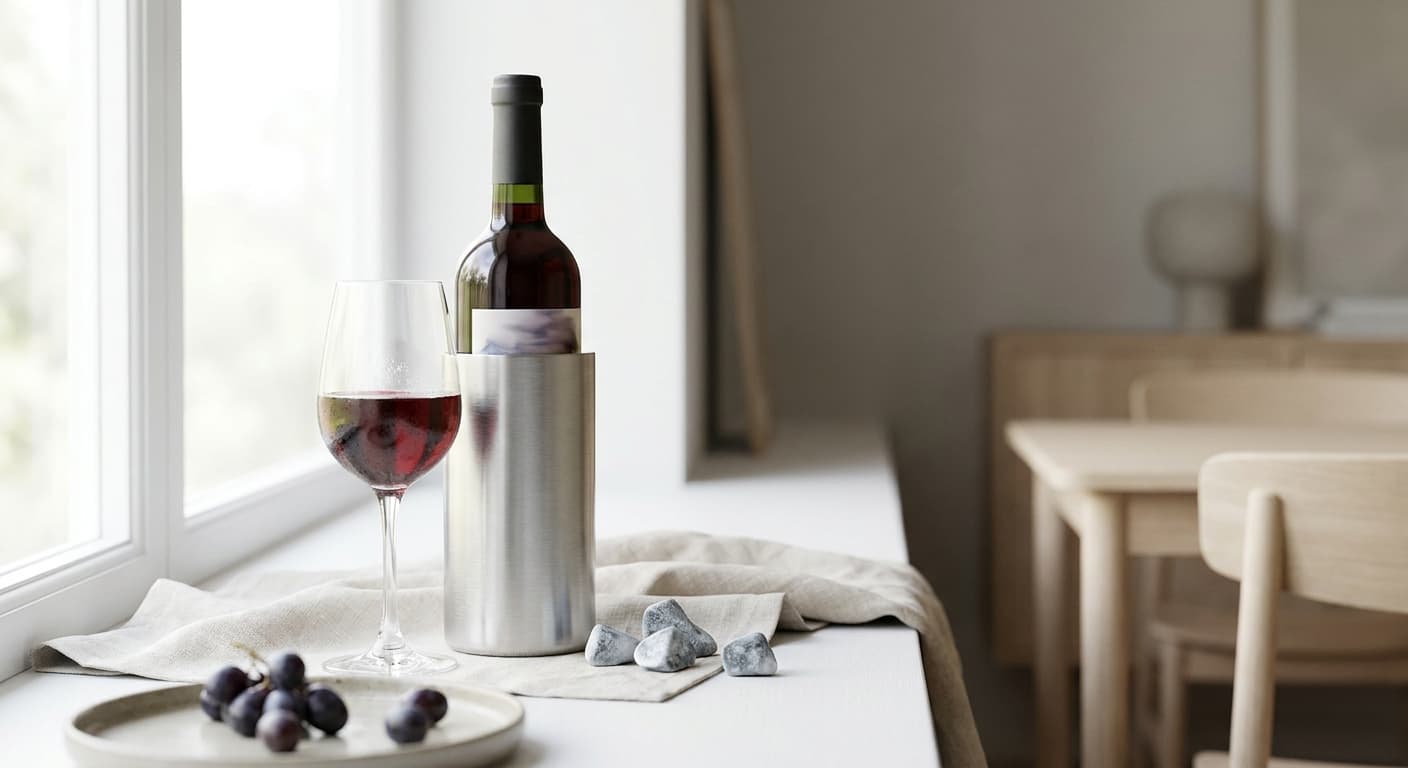
Some people put ice directly into white wine to keep it cold. This dilutes the wine after a few minutes and destroys the balance. Instead, use a good wine cooler on the table, or pour smaller amounts at a time and keep the bottle in the ice-water bath between refills.

A little rule of thumb you'll actually remember
I usually put it like this: think of the wine as a good ingredient you don't want to overcook. You wouldn't heat the salmon to 80 °C just because you find cold fish a bit odd. You'd do what brings out the best in the ingredient.
The same goes for wine. The right temperature isn't perfectionism – it's simply letting the wine do its job.
White wine from the fridge? Let it sit ten minutes in the glass.
Red wine that's been in the living room? Ten to twenty minutes in the fridge.
The rosé you forgot? Ice-water bath, twenty minutes, turn the bottle.
That's it. Simple enough to remember, and important enough to make a real difference. And if you're in doubt, remember that it's easier to warm up a wine that's too cold than to chill down one that's too warm. Your glass acts as a little heat source – hold it in your hand, give the wine a few minutes, and taste again. It often sorts itself out.
Next time you open a bottle, take a moment to think about the temperature. It takes five extra minutes, but it can make the difference between a decent wine and a wine you actually remember.