
It started with a bottle of Grillo left forgotten on the counter for thirty minutes during a barbecue evening. By the time we finally remembered it and poured, it was lukewarm enough to taste of nothing and everything at once – that kind of evasive, flat affair that's worse than if we'd just drunk water. That's the moment I tend to call the wine's barbecue grief.
And it doesn't have to happen. With a few simple tricks you can keep your white wine at the right temperature throughout the entire evening – without loading yourself down with fancy equipment or spending half your summer budget on wine storage.

The ice bath that actually works
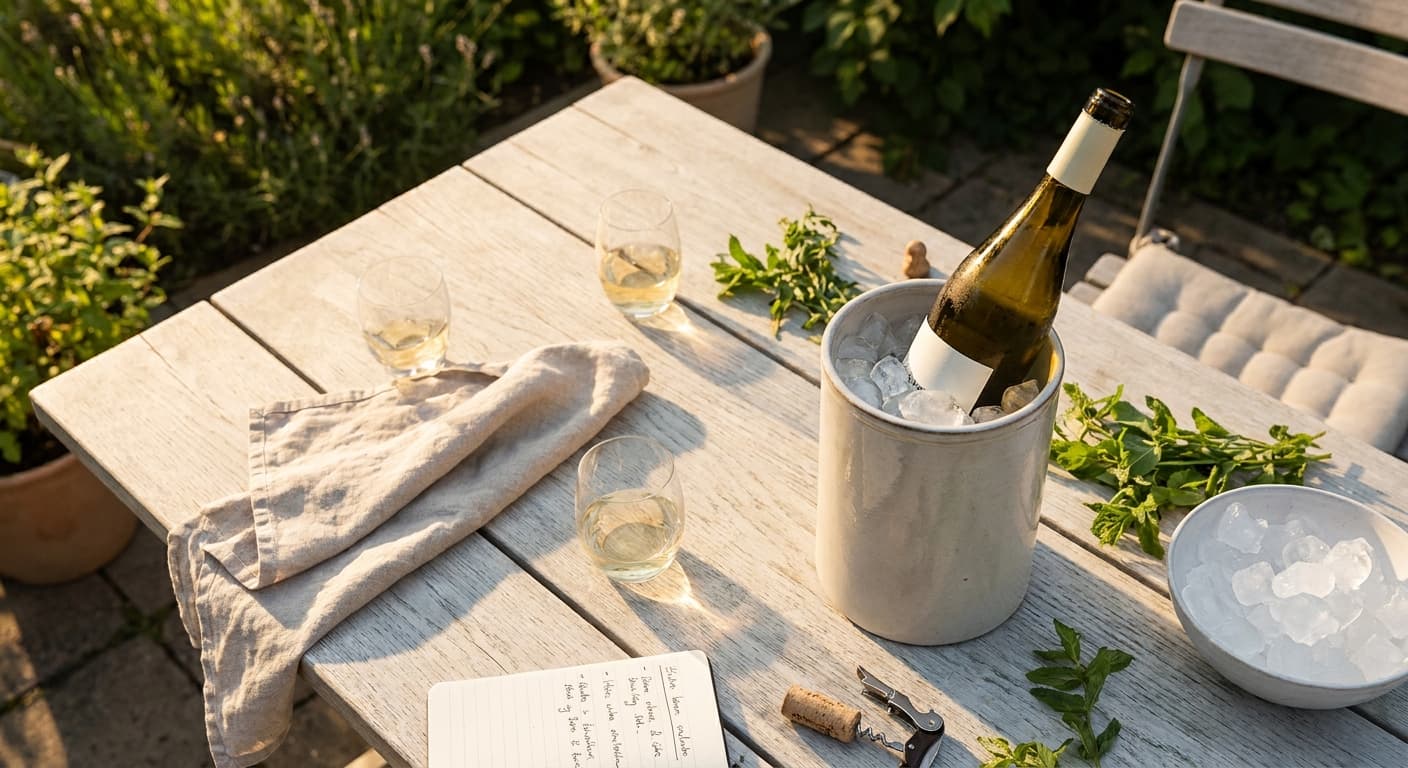
Here's something many people get wrong: they fill a bucket with ice and stick the bottle in it. It feels intuitively right, but pure ice has poor contact with the glass – there's air between the ice cubes that insulates more than it chills.
The solution is as simple as it is old: mix ice with cold water. Water conducts heat (and cold) far more effectively than air, and it fills every gap around the bottle. If you want it even colder faster, throw in a handful of salt. Salt lowers the freezing point of the water and makes the mixture colder than zero degrees – the same effect as sea ice.
A typical white wine will go from room temperature to ready to serve in under ten minutes in a good salt ice bath. Twenty minutes, and it's ice cold. That's faster than most refrigerators, and far faster than a thermos.
Here's how you do it:
- Fill the bucket halfway with ice cubes
- Pour in enough cold water to cover the ice cubes
- Add two to three large pinches of sea salt
- Lower the bottle in with the label facing up so you can see what you're drinking
- Wait ten minutes – then it's ready
Insulated bags and wine sleeves – are they worth it?
I've tested quite a few of them over the years, and the answer is: yes, but only as a supplement. A good neoprene sleeve keeps a pre-chilled bottle cold for one to two hours in direct sunlight. That's more than enough for a barbecue evening if you start at the right temperature.
The problem is that many people use the sleeves as a chilling method instead of an insulation method. They put a warm bottle in the sleeve and expect it to get cold. That doesn't happen. Insulate what is already cold – not what is warm.
The best sleeves I've used are those with a reflective outer layer and an extra inner sleeve you can dampen with water. Evaporation provides extra cooling – cheap chemistry that really helps on a warm day.

Order and timing are underrated
When you're planning a barbecue evening, think of the wines as ingredients with different needs – not as static bottles just waiting to be drunk.
Pour in order. Start with the lightest, freshest wine while it's still ice cold – a young Sauvignon Blanc or a light Grillo. As the evening progresses and the temperature drops (and the guests are a little more relaxed), you can move on to a more textured wine that actually benefits from having a little more temperature.
Pour half glasses. It might sound stingy, but a half glass stays cold much longer than a full one. Two sips keeps the wine at the right temperature; ten sips over a half-hour conversation gives you a lukewarm white wine.
Use the shade actively. There's a reason bars in southern Europe place their wine buckets in the shade of the tables. Direct sunlight is the enemy. Even a metal bucket of ice will lose the battle in direct summer sun after thirty minutes.
Which styles can handle a little extra warmth?
The truth is that not all white wines are equally vulnerable to temperature – and it's useful to know when planning what to bring.
More resilient:
- Fuller-bodied Chardonnay with oak barrel aging handles being served at 14–16 degrees well, and can therefore stand a little longer without being ruined
- Grillo from Sicily is made for warm conditions and holds up well. Mandrarossa Grillo 2025 is a easy-drinking all-rounder with fresh citrus, white flowers, and a salty minerality that recalls the Sicilian coastal landscape it comes from. It doesn't fall apart even if your glass has been sitting in the sun a minute too long
- White Rhône wines based on Marsanne and Roussanne have enough texture to retain their identity at higher temperatures
- Pinot Gris from Alsace with a little residual sweetness is surprisingly robust – the sweetness acts as a buffer against the heat
More vulnerable:
- Light, aromatic Riesling is perhaps the most temperature-sensitive of them all. Fine acidity and floral aromas disappear quickly once the wine starts to warm up. Müller-Catoir Herrenletten Riesling Erste Lage 2022 is an elegant wine from Pfalz with precise citrus and stone fruit aromas, crisp acidity, and a long, mineral finish – it deserves to be treated properly. Keep it ice cold and pour in small amounts
- Young Sauvignon Blanc with fresh grassiness and citrus loses most of what makes it good once the wine reaches ten to twelve degrees
- Pét-nat and light sparkling wine lose their bubbles and freshness quickly in the heat

Large format is underrated at barbecues
If you're inviting a crowd, you should consider bringing a large-format bottle. A three-litre bag-in-box or a magnum stays cold much longer than a standard 75-centilitre bottle, simply because the ratio of volume to surface area is more favourable. That's physics, not magic.
Pardon My French Côtes du Gascogne 2024 comes in a three-litre format and is made exactly for this situation – light, fresh, and unpretentious, with a lively acidity and hints of green apple and citrus that work with everything from grilled chicken to feta cheese and vegetables from the grill. Practical and easy-drinking without demanding pedantic temperature control.
A simple summary for your next barbecue evening
To wrap up without making it rocket science:
- Always pre-chill – put the bottles in the refrigerator at least three hours before you leave
- Use a salt ice bath for rapid chilling and active maintenance throughout the evening
- Use an insulated sleeve for transport and as a buffer between top-ups from the bucket
- Pour half glasses and stay in the shade
- Choose the right style – a fuller-bodied Grillo or Chardonnay for the warmer hours, a fresh glass of Riesling while it's still early and cool
And if someone leaves a bottle on the counter – you now know what to do. Salt ice bath, ten minutes, done.