
Now that August is drawing to a close and everyday life is quietly creeping back in, it's easy to fall back on the same store-bought bottles. But what if I told you that with a few simple steps you can make something much better yourself – and that it costs a fraction of what you spend on ready-made products?
Homemade sparkling water is really nothing more mysterious than carbonation, water, and a touch of creativity. With a soda maker or siphon as your base, and the season's herbs and berries as supporting players, you can mix your way to something truly special.
Homemade isn't just cheaper – it tastes like someone actually cared.— MAGNUS MIXMASTER
Soda maker or siphon – what's the actual difference?
Both work excellently, but they differ slightly in use. A soda maker uses CO₂ cartridges to carbonate cold water directly in the bottle. Fast, simple, and perfect for large volumes – and it sits happily on the kitchen counter without taking up too much space.
A siphon – that small, elegant gadget you might associate with bars and restaurants – is more precise and gives you the ability to carbonate already-flavored drinks. The advantage is that you can add the syrup directly into the siphon bottle and carbonate everything in one go. The downside? It holds 0.5–1 liter and uses CO₂ cartridges faster.
My advice: start with a soda maker for everyday use, and save the siphon for the slightly more serious projects – for example, when you want to impress guests with something unexpected in the glass.

The syrup – the heartbeat of your drink
A good homemade syrup is all you need to elevate a glass of carbonated water into something memorable. The base recipe is simple, and once you've made it once, you'll never go back.
Simple sugar syrup
Ingredients:
- 200 g sugar (or cane sugar for more depth and caramel notes)
- 2 dl water
Method:
- Bring the water and sugar to a boil until the sugar is completely dissolved.
- Remove the pan from the heat and add your flavorings while the syrup is still warm – the aromas infuse better that way.
- Leave to steep for the indicated time, strain, and cool.
- Pour into a sterilized bottle and store in the refrigerator for up to two weeks.
Three syrups that are perfect right now
1. Mint and lime
Add a large bunch of fresh mint and the zest of two limes while the syrup is warm. Leave to steep for 20 minutes, strain, and cool. Fresh, green, and lightly summery – perfect when the days are still warm and you want something that tastes like a holiday in a glass.
2. Ginger and lemon
Grate about 40 g of fresh ginger and squeeze the juice of one lemon. Add both to the warm syrup and leave to steep for 15 minutes. Lightly sharp and warm in the throat – it works surprisingly well with food, and is a natural relative of a proper ginger beer.
3. Rosemary and grapefruit
Two sprigs of rosemary and the zest of half a grapefruit. Leave to steep for 30 minutes. This is the grown-up version – a little bitter, a little herby, and excellent as an aperitif substitute on weekdays. Serve it over ice with a slice of grapefruit, and no one will miss the alcohol.

How to put it all together
The technique itself is simple, but there are a few small tricks that make a noticeable difference:
- Use ice-cold water. The colder the water, the more CO₂ it absorbs – and the better bubbles you get. Put the bottle in the freezer for ten minutes before carbonating.
- Add the syrup after carbonating. If you add sweetened water to the soda maker, the CO₂ reacts differently and you can get excess pressure. Carbonate the water plain, then stir in the syrup afterwards.
- Start cautiously with the amount. A good rule of thumb is 2–3 cl of syrup per 2 dl of carbonated water. Taste as you go – there's no fixed answer.
- Serve immediately. The carbonation disappears quickly once you mix, especially with syrup. Have the glass ready with ice and garnish prepared in advance.
Quick recipe: Mint-lime soda
Ingredients (1 glass):
- 200 ml carbonated water (ice-cold)
- 2–3 cl mint-lime syrup
- Juice of ½ lime
- Ice
- Fresh mint and a lime slice for garnish
Method:
- Fill the glass with ice.
- Pour over the carbonated water.
- Add the syrup and lime juice.
- Stir gently once – no more, or you'll lose the bubbles.
- Garnish with a sprig of mint and a lime slice. Serve immediately.

Use the berries while they're here
August is still the season for Norwegian berries, and they work brilliantly in homemade sparkling water. Raspberries, blackcurrants, and blueberries can easily be cooked into a rich, fruity syrup that tastes ten times better than anything you buy ready-made. Blackcurrants give a deep, slightly tart flavor that's reminiscent of something between redcurrants and blackberries. Raspberries are sweeter and more immediately accessible – and the color in the glass is simply beautiful.
A tip: mash the berries through a sieve over a bowl and add only the juice to the syrup – that way you avoid the seeds and get a clean, clear color in the glass. A few drops of lemon juice in the syrup also keeps the color fresh for longer.
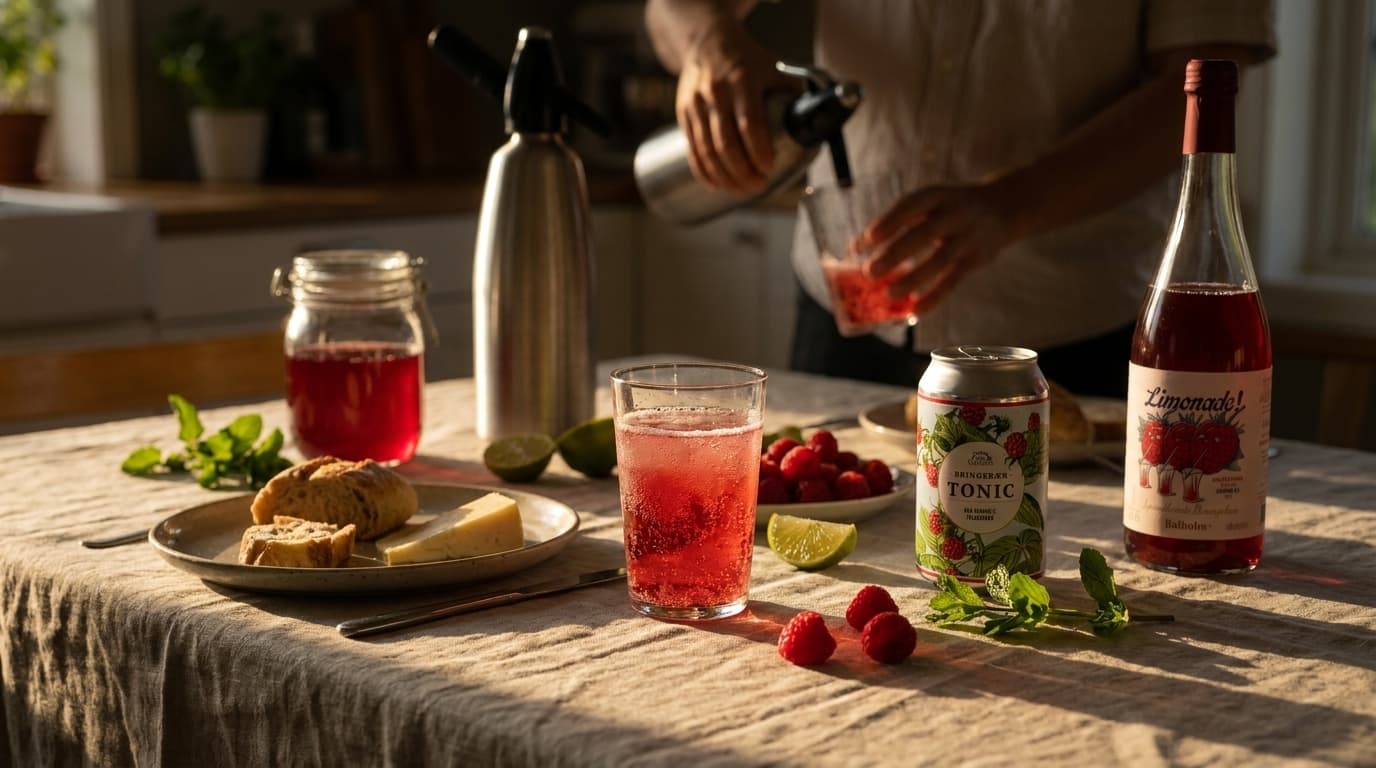
If you want a quick shortcut on a busy weekday, there are fortunately some good ready-made options. Balholm Sprudlande Bringebær Limonade is one of them – a Norwegian, sparkling raspberry lemonade that tastes fresh and natural, with a distinct berry character that isn't artificially sweet. It works well as a starting point if you want to mix further with your own herbs or a squeeze of citrus. Nøisom Tundra Bringebær Tonic is another good choice – drier and more aromatic, with a distinct tonic character and botanical notes that lift the sweet raspberry flavor in an elegant way. Both are non-alcoholic and suit children and adults alike.
Make it a habit, not a performance
The great thing about homemade sparkling water is that it doesn't have to be a big project. Cook a syrup on Sunday evening, store it in the refrigerator, and you have something to look forward to all week. It takes fifteen minutes, and it makes the everyday table a little more enjoyable – whether it's the school lunch being eaten, or a Friday evening that deserves an extra touch of "something of your own".
Feel free to vary according to what you have on hand. Half a bag of frozen mango, a few basil leaves, a leftover piece of ginger from Friday's dinner – anything can become a syrup. It's really not about the technique. It's about taking a little time to make something yourself – and discovering that it's actually better.