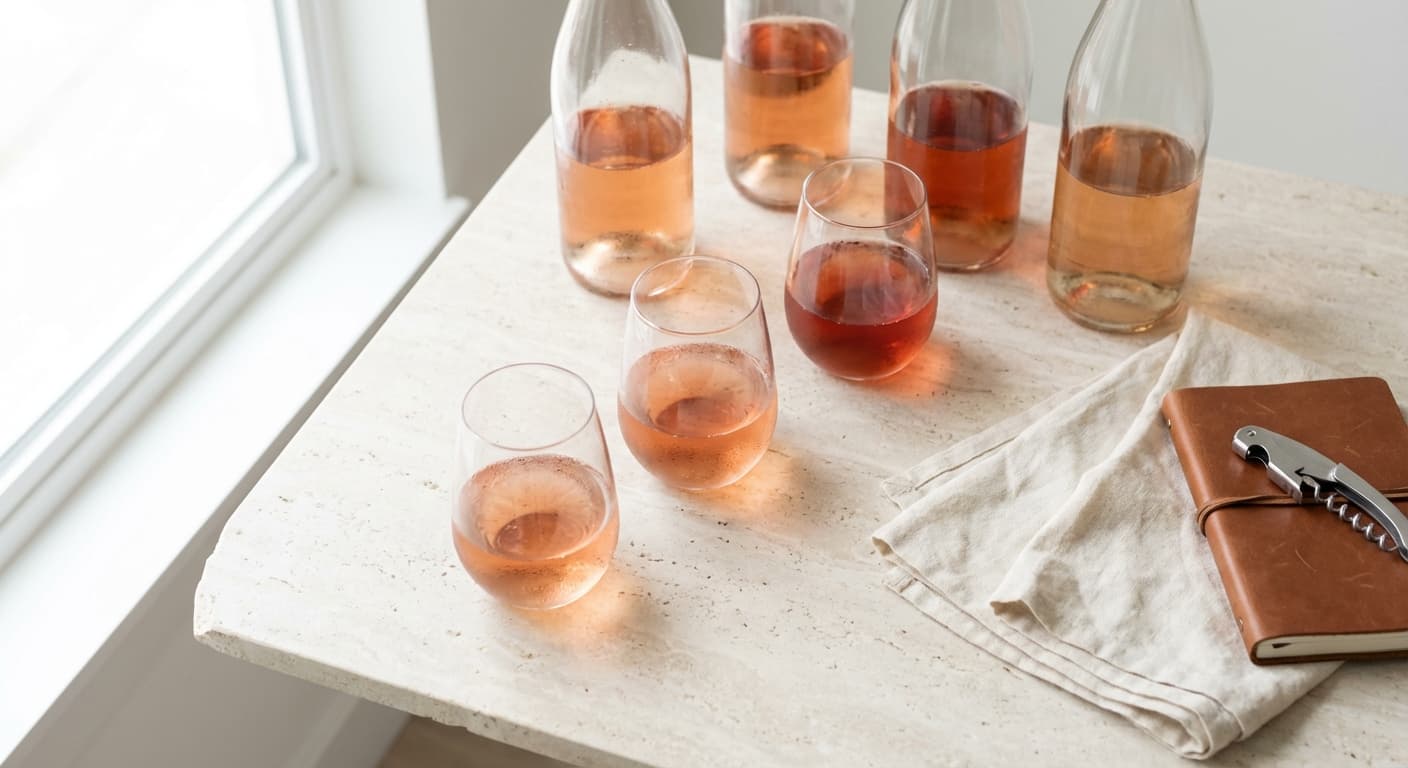

Standing in front of the rosé shelf on a Saturday morning in March, you're met with a wall of pale pink bottles. Some shimmer like morning mist over Provence. Others glow like a sunset in Sicily. And a few say nothing to you at all – they're just there, with their metallic capsules and cryptic labels.
The problem isn't that there are too many good rosé wines. The problem is that we far too rarely know what we're actually looking for. Is it the crisp, mineral bottle for fish and seafood? The round, fruity one that matches a cosy Friday evening with pizza? Or something with bubbles and acidity that opens dinner with style?
The answer is simple once you know what you're looking for. Let's divide the shelf into three clear style categories – and give you one concrete recommendation in each.
Category 1: Dry and mineral
This is rosé for those who are really fond of white wine but want a little more depth. Dry, mineral rosé wines are often as pale as salmon flesh, bright with acidity and elegant – with aromas of citrus zest, white pepper and something almost stony that makes your tongue cling slightly to the palate.
The mineral style is often dominated by wines from Provence, but Italy and the Basque Country also deliver fine examples. When you see a bottle that is almost translucent pink, with words like "sec", "brut" or "minerale" on the label, you're on the right track.
Recommendation: Rezábal Txakoli Rosé
Txakoli is one of Spain's most exciting wine regions – a small coastal strip in the Basque Country where local grape varieties are grown under a constant sea breeze. Rezábal Txakoli Rosé is precisely what you want from this category: razor-sharp acidity, a razor-fresh body and aromas of grapefruit, green apple and a touch of meadow flowers. The alcohol is pleasantly low at 10 percent, making it a dream companion for light food.
This wine has an almost salty aftertaste that reminds you that the grapes grew up with sea wind in their face. It's a wine that demands something of you – it wants attention, it wants the right food, it wants to be served ice cold. But give it that, and you get an experience that is far more interesting than most other rosé wines in the same price range.
Put it on the table alongside: Prawns with aioli and good bread. Grilled asparagus. A simple ceviche. Or simply as an aperitif while you wait for the guests to arrive.

Category 2: Fruity and juicy
Here you're allowed to relax a little. The fruity and juicy rosé wines are generous by nature – they give you strawberry, watermelon and rose petal without making it sweet. They are round in the mouth, forgiving with food and perfect for those who want something everyone around the table will enjoy.
This is the dinner-with-friends wine. The barbecue wine. The everyone-pours-themselves-another-glass-without-thinking-about-it wine. It doesn't require you to have read wine books or be able to pronounce Châteauneuf-du-Pape correctly. It just works.
These wines often come from Languedoc, southern Spain or Italy, and are typically made from grape varieties such as Grenache, Tempranillo or Sangiovese. The colour is more pronounced – think salmon pink or peach pink – and the aromas are immediately recognisable. Strawberry. Raspberry. Maybe a little citrus. Nothing complicated, but everything in place.
Recommendation: Côte Mas Rosé Aurore 2025
From Languedoc in southern France comes this excellent bottle that hits the bullseye for the category. Côte Mas is a reliable name from a region that has learned to take rosé wine seriously, and Aurore is dreamy in an everyday way: ripe strawberries, a hint of peach, a little almond in the finish. The structure is fresh enough to hold your attention, round enough not to demand anything special of the food.
What makes this wine a sure winner is the balance. It has enough fruit to be generous, enough acidity not to become boring, and a finish that is clean and fresh without being sharp. It's a wine you can serve to anyone, and everyone will like it.
Put it on the table alongside: A pulled pork burger. A lovely salad with feta, watermelon and mint. Lightly grilled chicken skewers. Or – and this is perfectly fine – a good pizza with prosciutto and rocket.

Category 3: Sparkling and complex
Sparkling wine rosé is the category that doesn't get enough love in Norway. We're good at reaching for the Champagne when there's something to celebrate, but forget that sparkling rosé – whether it's a Crémant, a Prosecco rosé or a lightly sparkling Txakoli – can do exactly the same job at half the price.
The bubbles in rosé wine do two things: they lift the fruit and make it brighter, and they cleanse the palate between each forkful. That's what we call a double win.
But let's also talk about the still rosé wines that have enough complexity to work on the same occasions. Wines from volcanic soil, from altitude, from places where the grapes have to fight a little to ripen – they have a natural elegance and a minerality that is reminiscent of good sparkling wines.
Recommendation: Tenuta delle Terre Nere Etna Rosato 2024
Nerello Mascalese from volcanic soil on Etna gives a rosé wine with natural minerality, a tart, almost blood-orange-like fruit and a dryness that is reminiscent of good Crémant. This is a wine that can hold its own alongside the most ambitious dishes. It has a complexity that means you notice something new with every glass.
The volcanic soil gives a distinct smoky undertone, almost as if the grapes remember the heat of the lava. The acidity is crisp and clean, the fruit is dark and concentrated – think pomegranate, blood orange, a little spice. This is a wine that can handle umami, something most rosé wines cannot.
If you're looking for bubbles with dinner, pair it happily with a sparkling Prosecco rosé as an aperitif and switch to the Etna Rosato with the food – it's an opening worth remembering.
Put it on the table alongside: Grilled squid with lemon and parsley. Tuna tataki. A flavourful pasta with bottarga. It can also handle a little umami, something most rosé wines cannot.

How to use the guide in practice
Next time you're standing in front of the shelf, ask yourself one simple question: What's the occasion?
Aperitif or fish → go for the dry, mineral style. Look for Provence, the Basque Country or Italy. Key words on the label: sec, brut, minerale, txakoli.
Dinner with friends, barbecue or pizza → go for the fruity and juicy style. Languedoc, southern Spain and a lower price point are your friends. Key words: Grenache, Tempranillo, Languedoc, Navarra.
Celebrations, special evenings or shellfish → go for the sparkling or complex. Crémant d'Alsace Rosé, Prosecco Rosé or a mineral Italian rosato. Key words: Etna, Crémant, volcanic soil, spumante.
A small bonus: temperature matters more than you think. Rosé is often served too warm, and that's when you lose precisely the freshness and acidity that makes it good. Chill it down to 8–10 degrees for the dry and mineral styles, and perhaps a couple of degrees more – around 10–12 – for the fruity and fuller-bodied ones. That's the difference between a wine that's merely fine and one that has you pouring yourself another glass.

One last thing
Rosé is not a compromise wine. It's not red wine that didn't quite make it, or white wine that tried something new. It's its own category, with its own set of possibilities. And now that the first warm days of spring are beginning to peek out along the coast, there's no better time than right now to find your favourite.
Take the guide to the shelf. Choose according to the occasion. And remember: the best rosé is the one you actually drink – not the one you left behind because the label was hard to decipher.
Cheers – and happy spring!